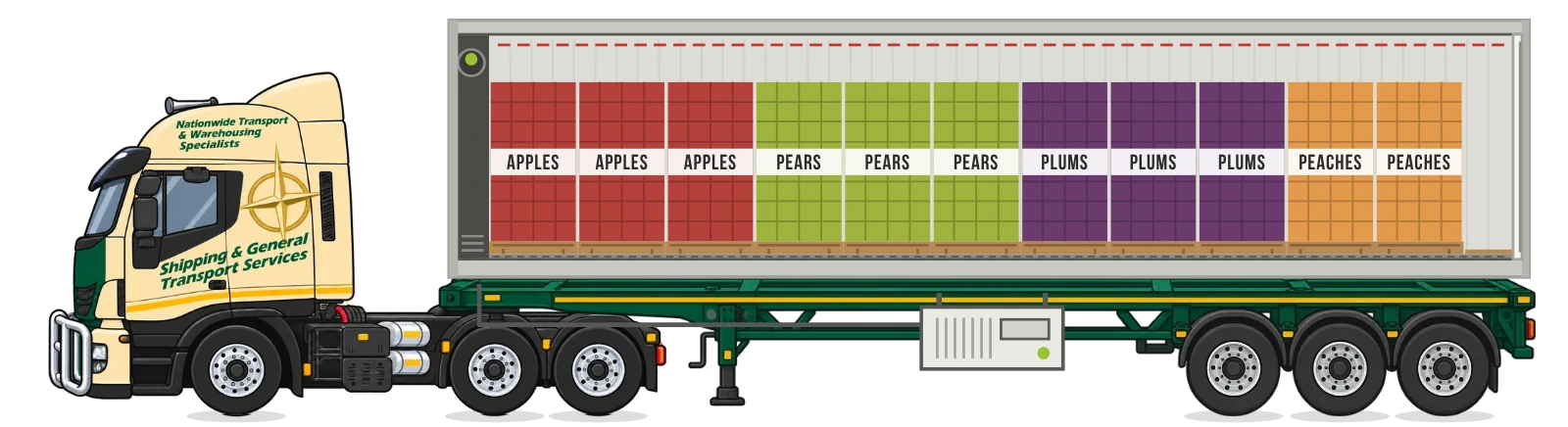
Perishable transport, product by product.
A reefer holds one set point, so check first which of your products can share it. Then we move the reefer between the ports and South Africa’s main centres on our underslung gensets, and the set point holds from loading to offloading.
- One set pointFor the whole reefer
- 10 gensetsUnderslung, on the road
- PTI on sitePPECB-certified facility
Only what shares the set point.
- 01
Prepared
The reefer is PTI’d at our PPECB-certified facility and set to the set point from your booking.
- 02
Loaded cold
At your cold store, only products that share the set point go in, below the red load line.
- 03
Air through the load
Doors shut, the unit blows cold air along the floor, up through the pallets and back.
- 04
On its genset
We take it to the port or your customer, set point held all the way.
Request a perishable transport quote
Your reefer
Step 1 of 7- Cargo
- —
- Reefer
- —
- Set point
- —
- Load at
- —
- Deliver to
- —
- When
- —
- Mix check
- Optional
One reefer, one set point
A reefer holds one temperature for the whole box, so a mixed load only works if every product can live with it. These are the main groups for fresh produce on a short trip, from the USDA mixed-load handbook.
What travels together
- 0 to 1.5 °CApples, pears, plums, peaches, berries
- 2.5 to 5 °COranges, tangerines, lemons, litchis
- 13 to 18 °CAvocados, bananas, mangoes, pineapples
- 0 to 1.1 °C, very humidLettuce, broccoli, cabbage, carrots
Our side of it
- 10 underslung gensetsSet point held, loading to offloading
- PTI before loadingPPECB-certified facility, IICL team
- Food-grade washingPassed a 100% food-grade audit
- 20 plug pointsIf it has to wait at our depot
Frozen and chilled food
R638 sets −18 °C for frozen fish and ice cream, −12 °C for other frozen food, 4 °C or colder for raw fish, poultry, offal and milk, and 5 °C or colder for other chilled food.
Loading it right
Every product at its carrying temperature, nothing above the red load line, open floor covered with board, and the unit started once the doors are shut.
Exporting a mix?
The PPECB may allow a mixed load or a compromise temperature only where stuffing to discharge takes 8 days or less, and it takes no liability for quality loss.
Where we operate
Our depot is at 69–71 Barlow Road, Jupiter, Germiston, about 5 km from City Deep, with our PTI facility and 20 reefer plug points on site. We move reefers on our gensets between the coastal ports and South Africa’s main centres, with Durban’s port on the N3.
- Germiston depot69–71 Barlow Road, Jupiter, Germiston 011 873 4786
- Durban · Greyville81 Berea Road, Greyville, Durban 031 305 0438

Part of Shipping & General Transport
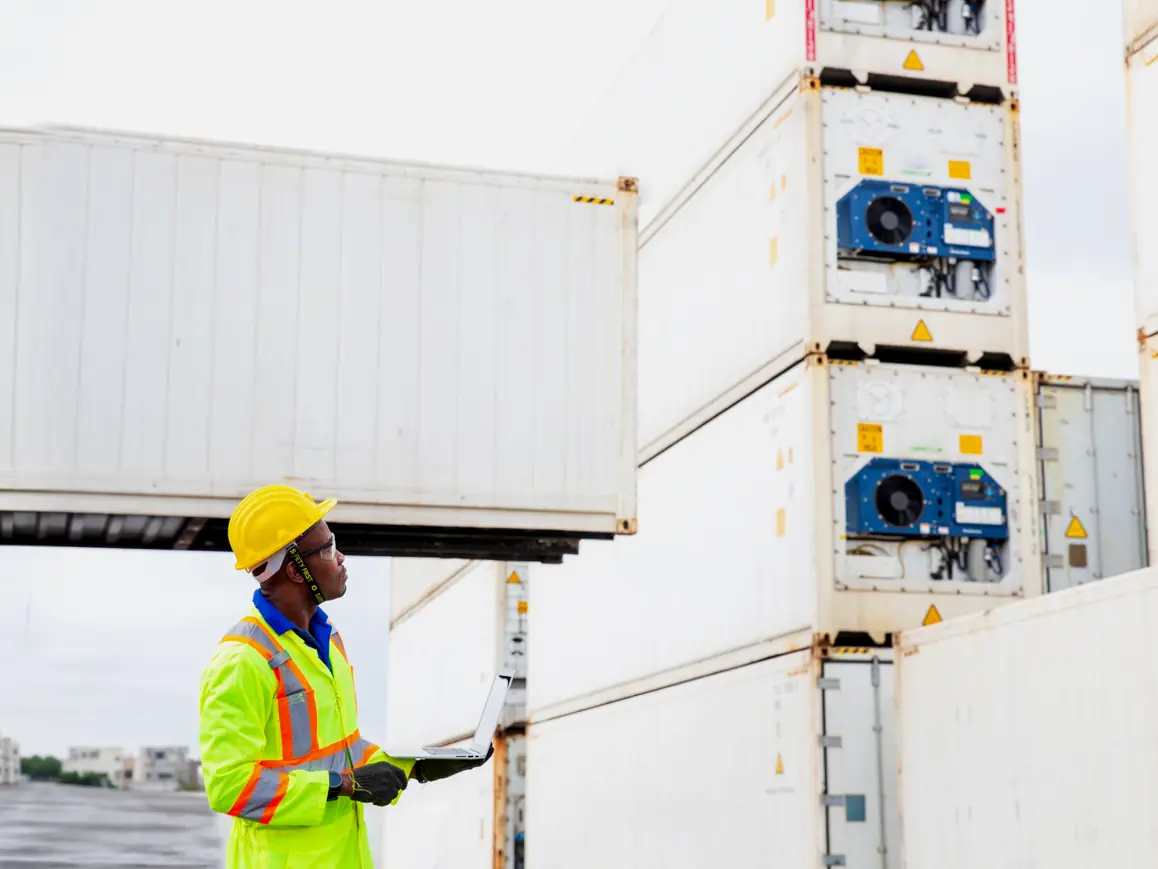
Shipping & General Transport is a privately owned South African logistics company built on trustworthiness, perseverance and reliability. Perishable Transport is one of its specialist services: reefers moved on its own gensets and prepared at its PPECB-certified PTI facility, from one company.
Visit shippingandgeneral.co.zaPerishable transport questions
Can’t find your answer? Our team is a phone call away.
Call 011 873 4786Which perishables can share one reefer?
Only products that are happy at the same temperature and humidity, and that don’t harm each other. The USDA mixed-load handbook sorts fresh produce into groups: apples, pears, plums and peaches at 0 to 1.5 °C, for example, or avocados, bananas and mangoes at 13 to 18 °C. The mix check on this page tells you which group your products fall in.
Why can’t bananas go in with apples?
Bananas are carried at 13 to 18 °C and apples at 0 to 1.5 °C. A reefer holds one set point for the whole box, so one of them would always be at the wrong temperature.
What does ethylene have to do with it?
Some fruit, such as apples, pears and stone fruit, gives off ethylene, and it can harm leafy and cabbage-family vegetables, even at the same temperature. The handbook keeps them apart, and UC Davis advises keeping ethylene below 1 ppm.
Can table grapes with SO₂ pads go with other fruit?
No. The handbook mixes grapes with other products only when there are no SO₂-releasing pads in the boxes and no SO₂ is used in the reefer.
What temperature for frozen and chilled food?
R638 sets −18 °C for frozen fish and ice cream, and −12 °C for other frozen food. Raw fish, shellfish, offal, poultry and milk go at 4 °C or colder, and other chilled perishables at 5 °C or colder. Frozen and chilled food need different reefers.
How long can a mixed load travel?
The produce groups are meant for short trips of about a week or less. For exports, the PPECB may allow a mix or a compromise temperature only where stuffing to discharge takes 8 days or less, and it takes no liability for quality loss.
How do you keep it at temperature on the road?
On one of our 10 underslung reefer gensets. They keep the set temperature from the moment we load the container until it’s offloaded, between the coastal ports and South Africa’s main centres.
Do you do PTIs?
Yes. Our reefer workshop, washing and PTI facility in Germiston is PPECB-certified and passed a 100% food-grade audit. Our IICL-certified team inspects, cleans, repairs and prepares reefers on the same site.
What if the reefer has to wait?
We can keep it powered on one of our 20 plug points at our depot in Germiston, over a weekend, a public holiday or as long as you need.
What do you need from me, and what does it cost?
The products, the set point from your booking or carrying instructions, where we load, where it goes, and the dates. We don’t publish prices: answer the seven short questions in the quote form, add the mix check if you like, and we come back with a quote.
Tell us what’s in the box.
Seven short questions, plus the mix check if you like. No prices online, just a quote on your actual load.